CLARK NST30 Fork Lifts
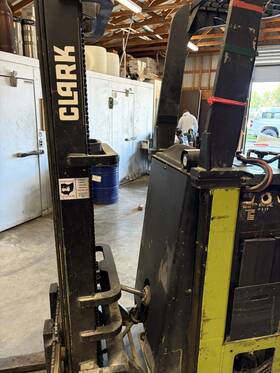
( Brand: Clark ), ( Manufacturer Part Number: NST30 ), ( Part Type: Fork Lift ), ( Load Capacity: Less Than 4, 000 Lb ), ( Tire Type: Solid Rubber ), ( Equipment Type: Stand-up Forklift )
Review CLARK Used Fork Lifts
The **NST30** is a robust, medium-duty electric forklift designed to deliver exceptional performance, reliability, and efficiency in a wide range of indoor and semi-indoor warehouse, distribution center, and light industrial environments. Engineered with precision by **Nissan Forklift Trucks**, a trusted name in material handling, the NST30 combines cutting-edge technology with ergonomic design to enhance operator comfort and productivity while minimizing operational costs. This compact yet powerful forklift features a **3,000-pound (1,360 kg) capacity**, making it ideal for handling standard pallets, crates, and bulk materials in tight spaces where maneuverability is critical. Its **electric propulsion system** ensures quiet, emission-free operation, reducing noise pollution and environmental impact while maintaining smooth, responsive performance across shifts. The forklift s **rear-wheel steering** and **narrow 36-inch (915 mm) wheelbase** allow for seamless navigation through narrow aisles, tight turns, and congested workspaces, maximizing storage efficiency in facilities where space is at a premium.
At the heart of the NST30 s efficiency lies its **high-performance battery system**, which delivers extended runtime and rapid recharging capabilities, minimizing downtime and keeping operations flowing seamlessly. The forklift is equipped with **Nissan s advanced battery management technology**, ensuring optimal charge cycles, longer battery life, and consistent power output even under demanding workloads. Operators benefit from an **intuitive, user-friendly control panel** with a **large, high-contrast LCD display**, providing real-time data on battery status, load weight, and operational metrics, while the **ergonomic seating position** and **adjustable controls** reduce fatigue during long hours of use. Safety is a cornerstone of the NST30 s design, featuring **standard stability control, automatic mast lowering, and a robust frame structure** to prevent tipping and ensure operator protection. Additionally, the forklift s **low-profile design** and **smooth hydraulic mast** enhance stability during lifting and lowering operations, even with heavy loads.
Built to withstand the rigors of daily use, the NST30 incorporates **high-strength, corrosion-resistant materials** in its frame, mast, and hydraulic components, ensuring durability and longevity in environments with varying temperature, humidity, and exposure to dust or debris. The forklift s **low-maintenance design** simplifies upkeep, with easy-access service points, sealed bearings, and **Nissan s proprietary hydraulic system** that reduces fluid leaks and extends component life. For added convenience, the NST30 is available in **multiple configurations**, including **standard reach trucks, order pickers, and pallet trucks**, allowing businesses to tailor the forklift to specific material handling needs. Whether used in a **retail distribution center, manufacturing plant, or e-commerce fulfillment facility**, the NST30 delivers a perfect balance of power, precision, and efficiency, helping organizations optimize their workflows while reducing operational expenses. With **Nissan s reputation for innovation and reliability**, the NST30 stands as a versatile, high-performance solution for businesses seeking a dependable electric forklift that can grow with their operations.
### Pros and Cons of Buying a New (Non-Specialized) Forklift (e.g., NST30 Series)
#### **Pros of Buying a New Forklift**
1. **Reliability and Performance** New forklifts are engineered to meet modern safety and efficiency standards, reducing the risk of mechanical failures and downtime. Brands like NST (now part of Komatsu) are known for robust build quality, ensuring consistent performance over the long term.
2. **Advanced Technology and Features** New models often come with modern advancements such as:- **Electric or hybrid engines** (if applicable) for lower emissions and operational costs.
- **Telematics and connectivity** for tracking usage, maintenance, and diagnostics.
- **Improved operator ergonomics**, reducing fatigue and enhancing safety.
- **Automatic load centering** and stability control systems for better handling.
3. **Warranty and Support** New forklifts typically come with manufacturer warranties (e.g., 1 3 years on parts and labor), providing peace of mind. Dealers and manufacturers also offer training, parts, and service networks, ensuring quick repairs if issues arise.
4. **Lower Total Cost of Ownership (TCO) Over Time** While the upfront cost is higher, new forklifts are more fuel-efficient, require less maintenance, and last longer than older or used models. This can lead to significant savings in the long run, especially for high-usage operations.
5. **Compliance with Safety Regulations** New forklifts are designed to comply with the latest OSHA, EU, or other regional safety standards, reducing legal risks and insurance premiums.
6. **Customization Options** Buyers can often specify attachments (e.g., side shifters, rotators, clamps) or configurations (e.g., electric vs. diesel) to match their specific workloads.
7. **Resale Value** New forklifts retain higher resale value compared to used ones, making it easier to recoup investment if upgrading later.
8. **Reduced Environmental Impact** Modern forklifts, particularly electric or LPG models, produce fewer emissions, aligning with sustainability goals.
---
#### **Cons of Buying a New Forklift**
1. **High Upfront Cost** New forklifts are significantly more expensive than used or refurbished models. For example, a new NST30 (or equivalent) electric forklift can cost between $30,000 and $50,000, depending on specifications, while a used one might be half that price.
2. **Depreciation** Forklifts depreciate rapidly, especially in the first few years. A new forklift may lose 20 40% of its value within the first year, which can be a financial burden if financing is used.
3. **Financing or Leasing Costs** If purchasing through a loan or lease, interest rates and monthly payments can add up over time, increasing the total cost of ownership. Leasing may also limit long-term ownership benefits.
4. **Overcapacity Risk** Businesses may purchase a new forklift with more capacity than needed, leading to unnecessary expenses for features or power that aren t utilized. This can result in higher maintenance costs and operational inefficiencies.
5. **Training and Adaptation Period** Operators may require additional training to adapt to new technology or controls, temporarily reducing productivity while they become familiar with the equipment.
6. **Storage and Space Requirements** New forklifts take up space in warehouses or yards, which may not be optimal if storage is limited. Additionally, they may require dedicated charging stations (for electric models) or fueling areas.
7. **Potential for Obsolescence** While less common today, rapid technological advancements could make certain features outdated sooner than expected. However, this is less of an issue with forklifts than with other equipment.
8. **Maintenance Costs (Early Phase)** Although new forklifts require less maintenance initially, some components (e.g., batteries in electric models) may have higher upfront costs or require specialized servicing.
---
### **Conclusion**
Buying a new forklift like the NST30 series (or equivalent) is a significant investment that offers long-term benefits in reliability, efficiency, and safety. It is ideal for businesses with:
- High usage volumes where downtime is costly.
- Strict compliance requirements or sustainability goals.
- The budget and space to justify the upfront cost.
- Plans to keep the forklift for 5 10 years or longer.
However, if a business operates with lower demand, limited space, or tight budgets, a used or refurbished forklift may be a more practical choice. The decision should balance immediate costs with long-term operational needs, warranty support, and resale value.
### **Recommendation**
**Buy a new forklift if:**- Your operation requires peak performance, minimal downtime, and compliance with modern standards.
- You can afford the upfront cost and have a clear plan for financing or leasing.
- The forklift will be used intensively (e.g., 8 hours daily) and you want to maximize its lifespan.
- You prioritize advanced features like telematics, ergonomics, or environmental benefits.
**Consider a used or refurbished forklift if:**- Your budget is constrained, and you can find a well-maintained, low-mileage used model with a strong warranty.
- Your usage is light to moderate, and you don t need the latest technology.
- You plan to upgrade or replace the forklift within 3 5 years.
For most industrial or warehouse operations with steady, high-demand needs, **a new forklift is the better long-term investment**, provided the financial and operational fit is right. Always conduct a thorough cost-benefit analysis, including maintenance, fuel, and labor savings, to ensure the purchase aligns with your business goals.
Details:
Run and works as should. It is an electric-powered, ride-on With charger.
specifications heavequipm:
- brand: Clark
- mpn: Nst30
- part type: Fork Lift
- load capacity: Less Than 4, 000 Lb
- tire type: Solid Rubber
- equipment type: Stand-up Forklift
shipping heavequipm:
payments heavequipm:
- credit card: Discover
- wallet: Google-pay
- other
general heavequipm:
- condition: Used
- Heavy Equipment, Parts Attachments > Heavy Equipment > klifts Telehandlers
offer heavequipm:
- best offers: True
- sold: 0
- quantity: 1
- options: Seller-arranged-local-pickup
- availability: In Stock
- started: May 25, 2026
seller heavequipm:
- rating: 100.0%
- city: Parkersburg, West Virginia
- # reviews: 607
returns heavequipm:
- policy: No Returns
Clark NST30 Is Similar To:
- 1015 Clark Trucloader Fork Lift Classic Built Circa (37% similar) The spare parts guy told me in 30 years he was with Clark, I only second person to ask about. About 7 years ago I was cleaning up at my friends injection molding factory and came across this tiny fork lift that dismantled. There is no emergency brake and the hydraulic pump was replaced with a ...(November 15th, 2018)
- 2348144 Clark Fork Lift Lb (46.4% similar) Shipping arrangements can be made through valley forklift is you cannot pick it up. The wiring has suffered from age and much been replaced to keep lift happy. This is a heavy duty Clark 15,000 lb fork lift. Near Sacramento. It is military surplus and new in the forks can be lifted to greater than ...(March 9th, 2019)
- C-500-s30 Lpg Clark Fork Lift (47.5% similar) Clark forklift, vertical aluminum LPG tank, it has been maintained well, and runs well...(September 25th, 2018)
- C30d Clark Forklift Model Cab Heater Triple Mast Dual For Wheels (38.3% similar) It has been a nice unit. Clark forklift, used but in good condition. Model C30D, Sn P232-1162-9677KF...(July 26th, 2018)
- C500-s100 Clark Lb Forklift For Sale Sanford Fl (51.9% similar) 9000 lb Clark forklift for sale Sanford fl image 1 of 7 condition: good make manufacturer: model name number: 9,000 cushion tires, propane engine, a transmission mast, side shift, include one tank...(March 30th, 2019)
- C500-ys80 Clark Used 7 000 (28.6% similar) While this lift had regular maintenance performed, it may not drip a drop of oil now and then or require other known to us. Item details: approx : forks are 72 long. Moves forward and backwards. For thousands of other industrial items. A used 7,000 Clark C500-YS80 forklift 72 forks triple stage mast...(June 16th, 2017)
- C500y200d Clark Lift Used (43.6% similar) Title information: vehicles titles may be held by banks or lenders as collateral for loans. However, OFFER123 disclaims any warranty as to the accuracy or working condition of vehicle equipment listed. Sell the item if deposit has not been received within 24 hours. Verify with the shipper for an ...(April 9th, 2018)
- C80d Clark Pneumatic Forklift Diesel Sideshift Fork Pos (28.2% similar) Unless any of these items are specified in sale. 2012 ' Clark C80D 18,000 lb pneumatic base capacity - engine: Cummins diesel dual solid tires auto trans. Serious inquiries only please. Net with your zip code for a free shipping quote. All funds in us dollars. All funds must clear our bank before ...(November 20th, 2018)
- Cfy40b Clark Forklift Propane Fork Reach Pneumatic Tires Forks (32.6% similar) Forklift Clark propane fork reach 106IN pneumatic tires 42IN forks...(June 11th, 2018)
- Ch80 Type G Clark Used (23.1% similar) Clark forklift: used 8,000 lb capacity, garage kept, hard rubber wheels, manufactured between ,starts good, runs no leaks, 12 foot lift, brakes work, mechanically sound, standard 4 ft forks...(August 25th, 2017)
- 10000 Clark Used Pound Forklift Propane Powered Run Great With Boom No Forks (26.4% similar) Used pound forklift Clark propane powered run great with boom no forks...(August 7th, 2016)
